
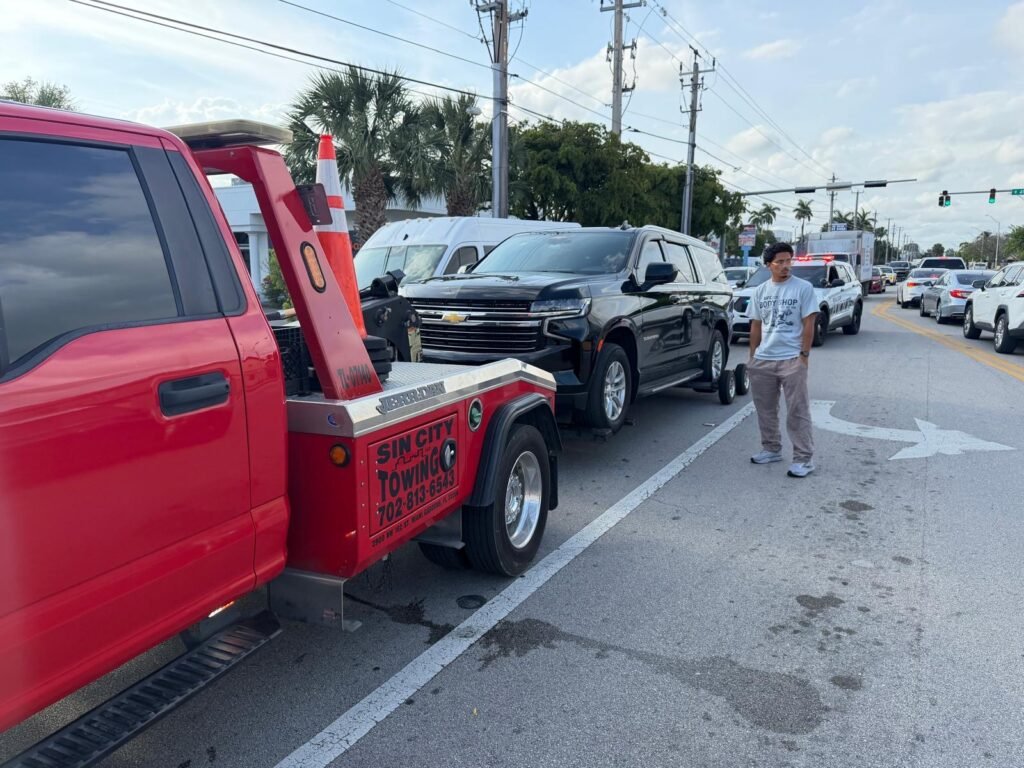
Should You Tow an AWD or 4WD Vehicle on a Flatbed?
You drive an all-wheel-drive (AWD) or four-wheel-drive (4WD) vehicle. Maybe it’s a Subaru, an Audi Quattro, a Jeep Wrangler, or a Ford F-150 4×4. You love the traction, the handling, and the confidence it gives you on Miami’s rain-slicked roads.
But then the unthinkable happens. Your car breaks down. The battery dies, the transmission fails, or you’re in an accident. You need a tow.
And suddenly, you’re faced with a question you may never have considered: How should my vehicle be towed?
The answer is simple but critical: Your AWD or 4WD vehicle MUST be towed on a flatbed—with all four wheels off the ground.
At Sin City Towing LLC, we see the aftermath of improper towing all too often. We’ve seen drivers who called a cheaper tow truck that used a wheel-lift, only to discover their transmission was destroyed, their transfer case was cracked, and they were facing a repair bill in the thousands.
Here’s everything you need to know about towing AWD and 4WD vehicles—and why flatbed towing Miami drivers trust is the only safe option.
The Short Answer: Yes, Always Use a Flatbed
The short and definitive answer to the question is: Yes, you should absolutely tow an AWD or 4WD vehicle on a flatbed. In fact, for most AWD and 4WD vehicles, flatbed towing is not just recommended—it’s required by the manufacturer.
When a vehicle is towed with any wheels on the ground, the drivetrain components are forced to rotate. If the transmission, transfer case, or differential is not properly lubricated (which happens when the engine isn’t running), severe damage occurs within seconds.
A flatbed tow truck lifts the entire vehicle off the ground. All four wheels are completely stationary. The transmission doesn’t move, the driveshaft doesn’t spin, and the differentials don’t rotate. Your vehicle simply rides as cargo.
Bottom line: If you drive an AWD or 4WD vehicle and you need a tow, insist on a flatbed. Don’t accept anything less.
Why AWD and 4WD Vehicles Are Different
To understand why flatbed towing is so important, you need to understand the difference between AWD, 4WD, and traditional two-wheel-drive (2WD) vehicles.
Traditional 2WD (Front- or Rear-Wheel Drive)
In a 2WD vehicle, only two wheels are powered by the engine. The other two wheels are free to roll without resistance. When towing a 2WD vehicle with a wheel-lift truck, the drive wheels are lifted off the ground. The non-drive wheels stay on the ground and roll freely. This is generally safe.
All-Wheel Drive (AWD)
In an AWD vehicle, power is sent to all four wheels at all times. There is no “disconnect” mechanism. The center differential, transfer case, and all differentials are linked. If any wheel is allowed to turn while the engine is off, the drivetrain components rotate without proper lubrication. This causes rapid wear and catastrophic damage.
Four-Wheel Drive (4WD)
In a 4WD vehicle, power can be sent to all four wheels, but there is usually a transfer case that allows the driver to shift between 2WD and 4WD modes. While some 4WD vehicles can be towed with the transfer case in “Neutral,” many newer models do not have this feature, and even when they do, there is still a risk of damage. The safest option is always a flatbed.
What Happens If You Tow an AWD or 4WD Incorrectly?
If you allow a wheel-lift tow truck (also called a hook-and-chain or sling truck) to tow your AWD or 4WD vehicle with two wheels on the ground, here’s what can happen:
1. Transmission Damage
The transmission is designed to be lubricated by fluid that is pumped when the engine is running. When the wheels turn while the engine is off, the transmission’s internal components rotate without proper lubrication. This causes metal-on-metal wear, scoring, and eventually catastrophic failure.
Repair Cost: $3,000 to $6,000 or more.
2. Transfer Case Damage
The transfer case (which distributes power between the front and rear axles) is another component that relies on engine-driven lubrication. Towing with wheels on the ground spins the transfer case without lubrication, causing it to overheat and destroy its internal gears and bearings.
Repair Cost: $1,500 to $4,000.
3. Differential Damage
The front and rear differentials are also at risk. When the drive wheels spin, the differentials rotate. Without the engine running to circulate fluid, the gears wear rapidly. Differential fluid can foam, overheat, and lose its lubricating properties.
Repair Cost: $1,000 to $3,000 per differential.
4. Driveshaft Damage
In some cases, the driveshaft can twist or snap if the vehicle is towed incorrectly. This is especially true for vehicles with a locked center differential.
Repair Cost: $500 to $2,000.
5. Tire and Wheel Damage
Dragging two wheels on the ground—especially if the transmission is locked—can cause flat spots, uneven wear, and even tire separation.
Repair Cost: $200 to $1,000 per tire.
6. Voided Warranty
Many manufacturers explicitly state in their owner’s manuals that AWD and 4WD vehicles must be towed on a flatbed. If you damage your vehicle by towing it incorrectly, your manufacturer may void your warranty and refuse to cover repairs.
The Total Cost of a Mistake
Let’s add this up. You call a cheap tow truck that offers a wheel-lift service for $75. Your transmission, transfer case, and differentials are destroyed. The repair bill: $5,000 to $10,000.
The cost of a professional flatbed tow from Sin City Towing LLC: Usually between $100 and $200.
When you do the math, the choice is obvious. A few extra dollars for a flatbed can save you thousands of dollars—and weeks of stress—in repair costs.
What About Vehicles with a “Neutral” Setting?
Some 4WD vehicles have a “Neutral” setting on the transfer case. This theoretically disconnects the drivetrain, allowing the vehicle to be towed with the rear wheels on the ground. But here’s the problem:
-
Not all vehicles have this feature. Even some that do don’t have it easily accessible.
-
It’s easy to get it wrong. If the transfer case isn’t properly in Neutral, damage occurs.
-
It’s not recommended by many manufacturers. Even if your vehicle has a Neutral setting, many manufacturers still recommend flatbed towing.
-
You’re still at risk. Even if the transfer case is in Neutral, the transmission and differentials may still be at risk depending on the design.
At Sin City Towing LLC, we don’t take chances. We always use flatbeds for AWD and 4WD vehicles. It’s the only way to guarantee your vehicle arrives without damage.
What About Electric and Hybrid Vehicles?
Electric vehicles (EVs) and hybrids add another layer of complexity. EVs have regenerative braking systems that can be damaged if the wheels turn while the vehicle is off. Some EVs also have electric motors that can generate electricity if spun, which could damage the battery or electrical system.
The rule is the same: All EVs and hybrids should be towed on a flatbed with all wheels off the ground. At Sin City Towing, we handle EVs with extra care to protect their sensitive electronics.
How Sin City Towing LLC Handles AWD and 4WD Towing
When you call Sin City Towing LLC for a tow, here’s what you can expect:
1. We Ask the Right Questions
Our dispatchers are trained to ask about your vehicle’s make, model, and drivetrain. If you have an AWD or 4WD vehicle, we immediately send a flatbed truck. We won’t send a wheel-lift truck that could damage your vehicle.
2. We Use Modern Flatbed Trucks
Our fleet is equipped with state-of-the-art flatbed trucks that can handle everything from compact sedans to heavy-duty SUVs and trucks. Our beds are designed with safety in mind, including proper wheel straps, tie-downs, and winches.
3. We Secure Your Vehicle Properly
Once your vehicle is loaded onto the flatbed, our drivers use heavy-duty straps to secure all four wheels. This prevents any movement during transit, ensuring your vehicle arrives exactly as it left.
4. We Drive With Care
Our drivers are experienced professionals who know how to handle AWD and 4WD vehicles with care. They drive smoothly, avoid sharp turns, and take precautions to protect your vehicle’s suspension and alignment.
5. We Communicate Clearly
We’ll explain the process to you, answer your questions, and let you know what to expect. We understand that towing can be stressful, and we want to put your mind at ease.
What to Do If You’re Stranded in Miami-Dade
If you drive an AWD or 4WD vehicle and you break down in Miami-Dade County, follow these steps:
Step 1: Pull Over Safely
If possible, pull over to the right shoulder or a safe parking area. Turn on your hazard lights.
Step 2: Assess the Situation
Is it a dead battery? A flat tire? A mechanical failure? Knowing what’s wrong will help you explain the situation to the dispatcher.
Step 3: Do Not Attempt to Tow or Push the Vehicle
Do not try to move the vehicle with another car or a rope. Do not push it. You could damage the drivetrain.
Step 4: Call Sin City Towing LLC
Tell our dispatcher that you have an AWD or 4WD vehicle. We’ll dispatch a flatbed truck immediately.
Step 5: Stay in Your Vehicle
Lock your doors, roll up your windows, and wait for us. You are safest inside your vehicle, especially on busy highways like I-95, the Palmetto, or the Turnpike.
Step 6: Let Us Handle It
Our driver will arrive, load your vehicle onto the flatbed, and transport it to your desired location. You don’t need to do anything else.
Common Miami-Dade AWD/4WD Vehicles We Tow
We regularly tow a wide range of AWD and 4WD vehicles across Miami-Dade, including:
-
Subaru (all models—Legacy, Outback, Forester, Crosstrek, WRX)
-
Audi Quattro (A4, A6, Q5, Q7, etc.)
-
BMW xDrive (3 Series, 5 Series, X3, X5, etc.)
-
Mercedes-Benz 4MATIC (C-Class, E-Class, GLE, GLC, etc.)
-
Jeep (Wrangler, Cherokee, Grand Cherokee, Compass)
-
Ford (F-150 4×4, Explorer, Escape, Bronco)
-
Chevrolet (Silverado 4×4, Tahoe, Suburban, Equinox)
-
Toyota (RAV4, Highlander, 4Runner, Tacoma, Tundra)
-
Honda (CR-V, Pilot, Passport—AWD models)
-
Nissan (Rogue, Pathfinder, Armada, Frontier 4×4)
-
Land Rover (all models)
-
Porsche (Cayenne, Macan, 911 with AWD)
If you drive any of these vehicles—or any other AWD or 4WD model—remember: flatbed only.
Why Some Towing Companies Don’t Use Flatbeds
If flatbed towing is so important, why don’t all towing companies use them?
-
Cost: Flatbed trucks are more expensive to purchase and maintain than wheel-lift trucks.
-
Training: Proper flatbed operation requires more training than wheel-lift operation.
-
Speed: Wheel-lift towing is faster for simple jobs, so some companies prioritize speed over safety.
At Sin City Towing LLC, we believe safety comes first. We invest in the best equipment and the best training because we care about your vehicle. We don’t cut corners, and we don’t take risks with your car.
How to Avoid a Tow Truck Scam
Unfortunately, there are some towing companies out there that don’t operate ethically. Here’s how to protect yourself:
1. Ask About Equipment
When you call a towing company, ask if they have a flatbed truck. If they say “yes” but send a wheel-lift, refuse the tow.
2. Check the Vehicle
When the tow truck arrives, look at the truck. Is it a flatbed? If not, don’t let them touch your vehicle.
3. Know Your Vehicle
Read your owner’s manual. Know what your manufacturer recommends for towing. This information is your best defense.
4. Keep Our Number Handy
At Sin City Towing LLC, you never have to worry about getting the wrong truck. We only use flatbeds for AWD and 4WD vehicles. Save our number so you always have a trusted option.
Final Thoughts: Protect Your Investment
Your AWD or 4WD vehicle is an investment. It’s not just a way to get from point A to point B—it’s a sophisticated piece of engineering that deserves care and respect. When it breaks down, you need to trust that it’s being handled properly.
A flatbed tow is not an “upgrade” or a “luxury.” It’s a necessity. It’s the only way to ensure your vehicle arrives at the mechanic without additional damage. It’s the only way to protect your warranty. And it’s the only way to protect your wallet.
At Sin City Towing LLC, we’re proud to be the go-to towing company Miami drivers trust for flatbed towing. We specialize in AWD and 4WD vehicles, and we understand the importance of doing the job right.
Don’t risk your vehicle with a wheel-lift truck. Don’t trust a company that cuts corners. Call Sin City Towing, and we’ll handle your vehicle with the care it deserves.
Need a Flatbed Tow in Miami-Dade Right Now?
If you need a flatbed tow truck near me and want a company you can trust, call Sin City Towing LLC immediately. We provide professional flatbed towing Miami drivers rely on, with fast response times and transparent pricing. Whether you need a tow truck Miami can dispatch quickly or reliable towing services Miami residents recommend, we’re here for you 24/7. Save our number and call us today—we’ll get your AWD or 4WD vehicle safely off the road!