
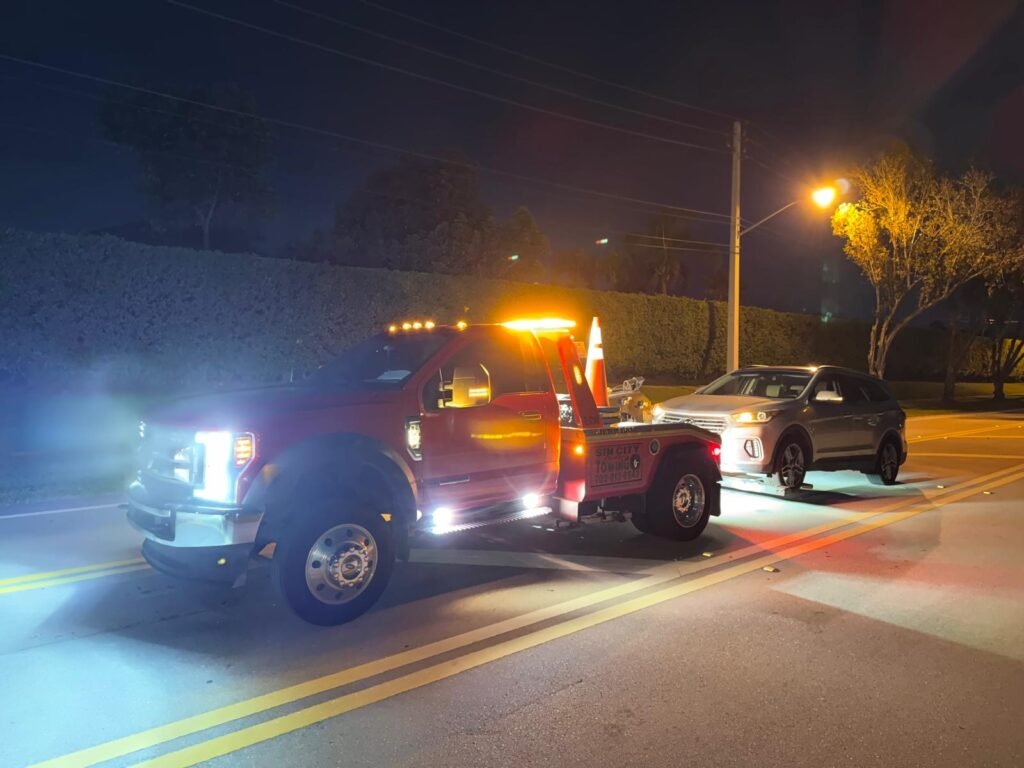
Why a Small Coolant Leak Can Turn Into a Major Miami Breakdown
You’ve noticed a small puddle under your car. It’s green, orange, or pink—and it’s definitely not water. You wipe it up, shrug, and tell yourself you’ll “get it checked out eventually.” After all, it’s just a little leak. How bad could it be?
In Miami? Potentially catastrophic.
At Sin City Towing LLC, we’ve towed hundreds of vehicles whose owners ignored a small coolant leak—only to find themselves stranded on the side of I-95 with steam billowing from under the hood and a seized engine that needs thousands of dollars in repairs.
Here’s the harsh reality of driving in Miami: our extreme heat turns a minor cooling system issue into a major breakdown in minutes, not hours. What might be a $200 hose replacement in a cooler climate becomes a $5,000 engine replacement here.
In this post, we’ll explain why coolant leaks are so dangerous in Miami, how to spot the warning signs, and when to call a professional tow truck Miami service before it’s too late.
Why Coolant Matters: The Basics
Before we dive into the dangers, let’s quickly review what coolant (also called antifreeze) does and why it’s so critical to your vehicle’s health.
What Coolant Does
-
Regulates Engine Temperature: Coolant absorbs heat from the engine and transfers it to the radiator, where it’s cooled by airflow.
-
Prevents Boiling: Coolant has a higher boiling point than water—typically around 265°F to 285°F, compared to water’s 212°F. This prevents your engine from boiling over in normal operation.
-
Prevents Freezing: While not a major concern in Miami, coolant also lowers the freezing point of the fluid to protect against cold weather.
-
Protects Against Corrosion: Coolant contains additives that prevent rust and corrosion inside the engine block, radiator, and heater core.
-
Lubricates the Water Pump: The water pump relies on coolant for lubrication. Without it, the pump can fail.
The Cooling System Components
Your cooling system is made up of several components that work together:
-
Radiator: Cools the hot coolant.
-
Water Pump: Circulates coolant through the engine and radiator.
-
Thermostat: Regulates the flow of coolant to maintain optimal temperature.
-
Hoses: Carry coolant between components.
-
Heater Core: Provides heat to the cabin (and also acts as a small radiator).
-
Coolant Reservoir: Holds extra coolant and allows for expansion and contraction.
A leak anywhere in this system can lead to low coolant levels, overheating, and engine failure.
The Miami Factor: Why Leaks Are More Dangerous Here
Miami’s climate is one of the most punishing environments for a vehicle’s cooling system. Here’s why:
1. Extreme Ambient Temperatures
Miami regularly sees temperatures in the 90s, with heat indexes well over 100°F. Your engine runs hotter simply because the air that cools the radiator is already hot. The cooling system works at maximum capacity almost all year round.
2. Stop-and-Go Traffic
When you’re stuck in traffic on the Palmetto, I-95, or the Turnpike, there’s minimal airflow through the radiator. Your engine relies almost entirely on the cooling fan. If the coolant level is low due to a leak, the fan can’t compensate.
3. Corrosive Salt Air
Living near the coast means salt air accelerates corrosion on metal components—including the radiator, hoses, and water pump. Corrosion weakens these parts, making leaks more likely and more severe.
4. Heat Speeds Up Fluid Breakdown
Coolant breaks down faster in high heat. When coolant degrades, it becomes acidic and starts eating away at the internal components of your cooling system. A small leak quickly becomes a larger one.
5. The “Florida Mile” Effect
In Miami, you’re often driving long distances at high speeds (the Turnpike, I-95, the Dolphin Expressway). A small leak that would be manageable in stop-and-go traffic becomes catastrophic when you’re cruising at 70 mph and suddenly lose coolant pressure.
The Small Leak → Big Breakdown Timeline
Here’s how a seemingly minor coolant leak can destroy your engine in a matter of minutes:
Stage 1: The Tiny Leak
You notice a few drops of coolant on your driveway or garage floor. Maybe a hose has a small crack, or the radiator has a tiny pinhole. The leak is slow—you might lose a cup of coolant over a week. Your temperature gauge still reads normal.
What You Think: “I’ll get it checked out next oil change.”
The Reality: The leak is slowly getting worse. Heat and pressure are working to widen the crack. Corrosion is accelerating.
Stage 2: The Leak Worsens
The small crack turns into a larger one. Now you’re losing coolant faster. You might notice the low coolant light flashing on your dashboard. The temperature gauge starts creeping up, especially in traffic.
What You Think: “I’ll just top it off with water and keep driving.”
The Reality: Adding water lowers the boiling point of your coolant, making overheating more likely. And you’re just masking the problem—the leak is still there.
Stage 3: Rapid Coolant Loss
You’re driving on the Turnpike. The crack finally gives way. Coolant gushes out. Your temperature gauge spikes. The engine warning light flashes. Steam pours from under the hood.
What You Think: “I’ll just make it to the next exit.”
The Reality: Your engine is already overheating. The temperature is rising fast. You have less than a minute to pull over before catastrophic damage occurs.
Stage 4: Engine Damage
The engine’s metal components expand due to extreme heat. The cylinder head warps. The head gasket fails. Coolant mixes with oil. The engine seizes.
What You Think: “I wish I had fixed that leak when I first noticed it.”
The Reality: You’re facing a repair bill of $4,000 to $7,000 for a new engine. The $200 hose replacement you put off now costs thousands.
Common Causes of Coolant Leaks in Miami
Understanding the common causes can help you spot problems early—and avoid a breakdown.
1. Radiator Corrosion
Salt air and acidic coolant eat away at the radiator’s metal fins and tubes. Over time, pinhole leaks develop. In Miami, radiators often need replacement every 5 to 7 years.
2. Failed Hoses
Rubber hoses degrade due to heat and age. The ends where they connect to the radiator and engine are especially vulnerable. A bulging or cracked hose is a leak waiting to happen.
3. Water Pump Failure
The water pump has seals and bearings that wear out. When the seal fails, coolant leaks out of the weep hole. This is often a slow leak that goes unnoticed until it’s too late.
4. Heater Core Failure
The heater core is essentially a small radiator inside your dashboard. When it leaks, you’ll notice a sweet smell inside the cabin, foggy windows, or a wet passenger-side floor mat.
5. Blown Head Gasket
A blown head gasket can allow coolant to leak into the engine cylinders (where it burns as white smoke) or into the oil (creating a milky sludge). This is a serious issue that requires immediate attention.
6. Cracked Engine Block or Cylinder Head
Extreme heat can actually crack the metal of the engine block or cylinder head. This is a catastrophic failure that often requires an engine replacement.
The Warning Signs You Should Never Ignore
If you experience any of these symptoms, your cooling system is telling you something is wrong. Don’t ignore them.
1. A Sweet Smell
Coolant has a sweet, syrupy odor. If you smell it inside or outside your car, you have a leak.
2. Puddles Under Your Car
Green, orange, or pink fluid on the ground is coolant. (If it’s red, it’s transmission fluid; if it’s brown or black, it’s oil.) Don’t ignore any puddles.
3. The Temperature Gauge Spikes
If your temperature gauge moves into the red zone, pull over immediately. Do not wait.
4. The Low Coolant Light Comes On
This warning light means your coolant level is dangerously low. Add coolant (50/50 mix) and get to a mechanic.
5. Steam or Smoke Under the Hood
Steam means coolant is boiling. Shut off the engine immediately.
6. White Smoke from the Exhaust
This can indicate a blown head gasket—coolant is burning in the engine.
7. The Engine Runs Rough or Misfires
Coolant leaking into the cylinders can cause misfires and rough running.
8. Foggy Windows or a Wet Floor Mat
This indicates a heater core leak.
What to Do If You Suspect a Coolant Leak
If you notice any of the warning signs above, follow these steps:
Step 1: Pull Over Immediately
If your temperature gauge is climbing, pull over as soon as it’s safe. Do not wait for the next exit. Do not try to “make it.”
Step 2: Turn Off the Engine
Shut off the engine immediately. Let it cool down completely—this can take 30 minutes to an hour.
Step 3: Do Not Open the Hood Immediately
The cooling system is under high pressure when hot. Opening the cap can release scalding steam and boiling coolant, causing severe burns. Wait until the engine is cool.
Step 4: Check the Coolant Level
Once the engine is cool, check the coolant reservoir. If it’s low, add a 50/50 mix of coolant and water. Do not use pure water—it lowers the boiling point and offers no corrosion protection.
Step 5: Look for Visible Leaks
With the engine off and cool, look under the car and under the hood for visible leaks. Check hoses, the radiator, and the water pump.
Step 6: Call Sin City Towing LLC
If you can’t identify the leak, if the leak is significant, or if the car has overheated, do not drive it. Call us for professional roadside assistance Miami drivers trust. We’ll tow your vehicle safely to a mechanic.
Why You Shouldn’t Drive with a Coolant Leak
Many drivers think they can “top up the coolant” and keep driving. Here’s why that’s a dangerous gamble:
1. The Leak Won’t Fix Itself
Adding coolant just masks the problem. The leak is still there. You’ll lose coolant again—probably at the worst possible moment.
2. Water Is Not a Solution
Using water instead of coolant lowers the boiling point and reduces corrosion protection. In Miami’s heat, water will boil out quickly, leaving you stranded.
3. Overheating Causes Immediate Damage
When an engine overheats, the damage is rapid and severe. Cylinder heads warp, head gaskets blow, pistons seize, and bearings fail. There is no “gentle” overheating.
4. You Could Be Stranded
The leak will worsen as you drive. Pressure and heat will make the crack or hole larger. You could lose all coolant within minutes.
5. Repairs Are Much More Expensive
A $200 hose or a $500 water pump is cheap compared to a $5,000 engine replacement. Fixing the leak early saves you thousands.
How Sin City Towing LLC Can Help
If you suspect a coolant leak or your car has overheated, we’re here to help. Here’s what we offer:
1. Fast Response Times
We dispatch the nearest truck to your location immediately. We know that overheating is an emergency, especially in Miami’s heat.
2. Safe Flatbed Towing
If your engine has overheated, the last thing you want is more stress on the vehicle. We use flatbed trucks to transport your car safely without additional wear.
3. Professional Assessment
Our drivers can assess the situation and help you understand if the car might be drivable (in rare cases) or if it needs a tow. We’ll give you honest advice.
4. 24/7 Availability
Coolant leaks don’t happen at convenient times. We offer 24/7 emergency towing Miami services so you’re never stranded alone.
5. Transparent Pricing
No hidden fees, no surprises. We provide upfront quotes so you know exactly what to expect.
6. Knowledge of Local Mechanics
We work with trusted mechanics throughout Miami-Dade. If you don’t have a regular shop, we can recommend one.
Preventing Coolant Leaks in Miami’s Heat
While some leaks are unavoidable, there are steps you can take to reduce your risk:
1. Flush and Replace Coolant Regularly
Manufacturers typically recommend a coolant flush every 30,000 to 50,000 miles or every 2 to 5 years. In Miami’s heat, we recommend the lower end of that range.
2. Inspect Hoses and Belts
Check hoses for cracks, bulges, soft spots, or leaks. Squeeze them—they should be firm but not hard. Replace them if they feel spongy or brittle.
3. Check the Radiator
Look for signs of corrosion, bent fins, or leaks. Keep the radiator clean and free of debris like leaves and bugs.
4. Monitor Your Temperature Gauge
Make a habit of glancing at your temperature gauge regularly. If it moves higher than usual, investigate.
5. Watch for Warning Lights
Don’t ignore the low coolant light or the check engine light. They’re there to warn you of problems.
6. Have Your System Pressure-Tested
A mechanic can pressure-test your cooling system to check for leaks you can’t see. This is especially useful for older vehicles.
7. Use the Right Coolant
Make sure you’re using the correct type of coolant for your vehicle. Different manufacturers require different formulations. Using the wrong coolant can cause corrosion and damage.
8. Check Your Coolant Level Regularly
Pop the hood and check the coolant reservoir at least once a month. It’s a simple habit that can save you thousands.
What to Do If Your Car Overheats While Driving
If your temperature gauge spikes while you’re driving, follow these steps:
1. Turn Off the AC
Turn the air conditioning off. This reduces the load on the engine.
2. Turn the Heat On Full Blast
This sounds counterintuitive, but it pulls heat from the engine into the cabin. It will be uncomfortable, but it can help cool the engine slightly.
3. Pull Over Safely
Find a safe place to stop—a shoulder, a parking lot, or an exit ramp. Turn on your hazard lights.
4. Shut Off the Engine
Turn the engine off immediately. Do not let it idle.
5. Wait 30-60 Minutes
Let the engine cool down completely. Do not open the hood until the engine is cool to the touch.
6. Call Sin City Towing LLC
Don’t try to drive on. Even if the temperature gauge drops, the damage may already be done. Call us for a safe tow.
The Cost Comparison: Prevention vs. Repair
Let’s look at the numbers:
| Issue | Repair Cost |
|---|---|
| Coolant hose replacement | $150 – $400 |
| Radiator replacement | $500 – $1,200 |
| Water pump replacement | $500 – $1,000 |
| Head gasket replacement | $1,500 – $3,000 |
| Engine replacement | $4,000 – $7,000 |
A $200 repair today can prevent a $5,000 repair tomorrow. Don’t wait.
Real Stories from the Road: What We’ve Seen
At Sin City Towing LLC, we’ve seen the full spectrum of coolant-related breakdowns. Here are two examples:
The “Just Top It Off” Driver
A driver on the Turnpike noticed a small leak a week earlier. He kept adding water “just to get by.” On a 95-degree day, his engine overheated catastrophically. The cylinder head warped, the head gasket blew, and the engine seized. The repair bill: $4,800. The hose replacement he skipped: $200.
The Quick Thinker
Another driver noticed a small puddle of green fluid in her driveway. She had it checked immediately. The mechanic found a small crack in a hose and replaced it for $180. She avoided a breakdown, kept her engine healthy, and saved thousands.
Which driver do you want to be?
Final Thoughts: Don’t Wait—Act Now
A small coolant leak in Miami is not a minor issue. It’s a warning sign that your cooling system is under stress. Ignoring it is a gamble you can’t afford to take.
Miami’s heat is relentless, and your cooling system is the only thing standing between you and a catastrophic engine failure. Respect the warning signs. Address leaks immediately. And when you need professional help, call the team you can trust.
At Sin City Towing LLC, we’re here to help Miami drivers stay safe on the road. We provide fast, professional towing service Miami residents trust, with 24/7 availability and transparent pricing. Whether you need a simple tow or emergency roadside assistance, we’ve got your back.
Need a Tow in Miami Right Now?
If your car is overheating, leaking coolant, or showing warning signs and you need a tow truck Miami can dispatch immediately, call Sin City Towing LLC right now. We provide reliable roadside assistance Miami drivers trust, along with emergency towing Miami and 24 hour tow truck Miami services. Don’t risk your engine—call us today and let us get you and your car to safety fast!