
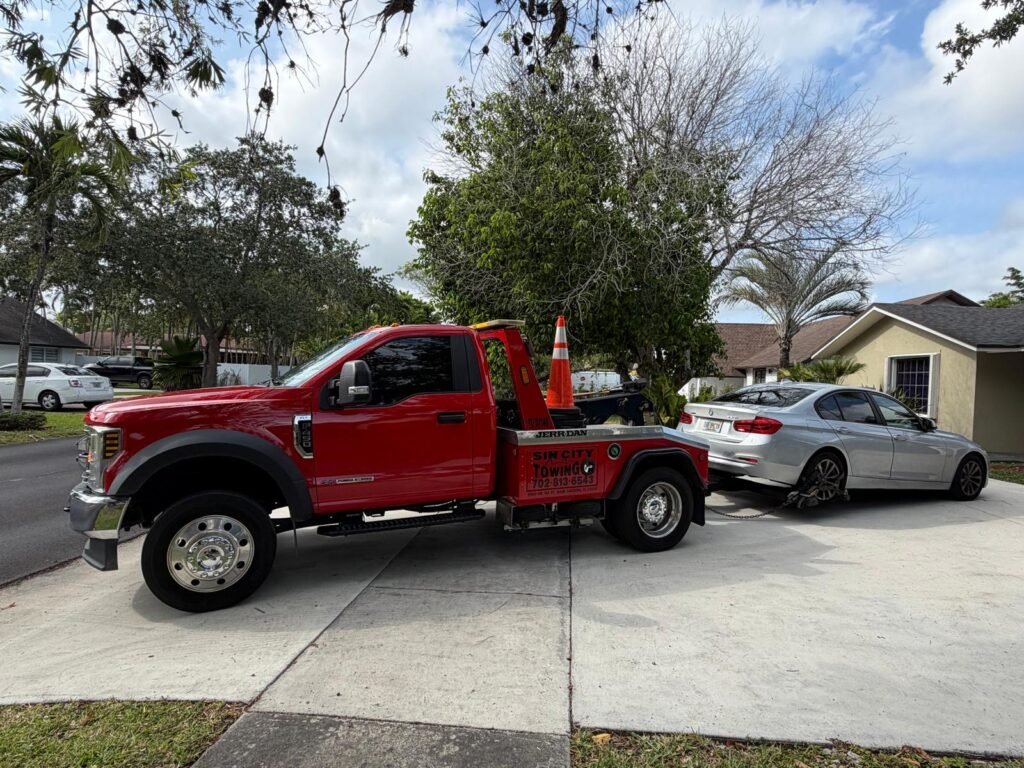
Why More Drivers in Florida City Are Choosing Flatbed Towing
If you’ve driven around Florida City recently, you might have noticed something: more and more tow trucks on the road are flatbeds. And there’s a good reason for that. Florida City drivers are increasingly choosing flatbed towing over traditional methods—and for good reason.
At Sin City Towing LLC, we’ve seen this shift firsthand. As the gateway to the Florida Keys and home to a diverse mix of vehicles—from agricultural trucks and SUVs to luxury cars and electric vehicles—Florida City presents unique towing challenges. Flatbed towing offers the safest, most reliable solution for many of these vehicles.
In this guide, we’ll explain why flatbed towing is becoming the preferred choice for Florida City drivers, what makes it safer, and why you should consider it for your next tow.
What Is Flatbed Towing?
Before we dive into why it’s so popular, let’s quickly define what flatbed towing is.
Flatbed towing is a method where your entire vehicle is loaded onto a flat, level bed on the back of a truck. All four wheels are completely off the ground and secured to the bed. Your vehicle is transported without any wheels touching the road.
This is different from traditional towing methods like:
-
Wheel-lift towing: Only two wheels are lifted off the ground.
-
Dolly towing: Two wheels are placed on a dolly while the other two roll on the road.
-
Hook and chain towing: An older method that uses chains and can cause damage.
With flatbed towing, your vehicle is fully supported and protected throughout the journey.
Why Florida City Drivers Are Switching to Flatbed Towing
Florida City’s unique driving environment makes flatbed towing the smart choice for many drivers. Here’s why.
1. Florida City’s Vehicle Mix
Florida City is home to a wide variety of vehicles. From agricultural trucks and work vehicles to family SUVs and luxury cars, the diversity means that traditional towing isn’t always the safest option.
Agricultural and Work Vehicles: Many Florida City residents drive heavy-duty trucks and equipment for work. These vehicles are heavy and can be difficult to tow safely with traditional methods.
SUVs and Crossovers: With families growing and the need for versatile vehicles, SUVs are everywhere in Florida City. Many of these are all-wheel drive (AWD) or four-wheel drive (4WD), which require flatbed towing to protect the drivetrain.
Luxury Vehicles: Florida City has a growing population of drivers with high-end vehicles like BMWs, Audis, and Mercedes-Benz. These cars have low ground clearance, sensitive electronics, and expensive bodywork that can be damaged by traditional towing.
Electric Vehicles (EVs): More Florida City drivers are making the switch to electric vehicles like Teslas and other EVs. These vehicles have sensitive battery packs and complex drivetrains that are best protected with flatbed towing. Many EV manufacturers explicitly recommend flatbed towing.
Modified Vehicles: Florida City’s car culture includes many modified vehicles with lowered suspensions, custom body kits, and aftermarket wheels. Flatbed towing is the only safe way to transport these vehicles without causing damage.
2. The Gateway to the Keys
Florida City is the last stop before the Florida Keys. Many drivers pass through Florida City on their way to Key Largo, Islamorada, Marathon, or Key West. The Overseas Highway is a long, remote road with unique challenges, and flatbed towing is often the safest choice for vehicles that break down along the route.
Long-Distance Towing: If your vehicle breaks down in the Keys, it may need to be towed all the way back to Florida City or beyond. Flatbed towing protects your vehicle during long-distance transport, preventing wear on tires and drivetrain components.
Bridge Breakdowns: Breaking down on one of the Overseas Highway’s 42 bridges—including the Seven Mile Bridge—is dangerous. Flatbed towing provides a secure and safe way to transport your vehicle off the bridge.
Remote Locations: Some parts of the Keys have limited access for traditional tow trucks. Flatbeds can handle these situations better.
3. Protecting Your Investment
Your vehicle is one of your biggest investments. Whether it’s a work truck, a family SUV, or a luxury car, you want it protected during transport. Flatbed towing offers the best protection.
No Drivetrain Damage: With all four wheels off the ground, there’s no stress on the transmission, differential, or drivetrain.
No Tire Wear: Towing with wheels on the ground causes tire wear. Flatbed towing eliminates this entirely.
No Debris Damage: Traditional towing exposes your vehicle’s undercarriage to road debris. Flatbed towing keeps your vehicle clear of the road.
No Scraping: For low-clearance vehicles, flatbed towing eliminates the risk of scraping bumpers or undercarriage components.
Peace of Mind: Knowing your vehicle is fully secured and protected during transport gives you peace of mind.
4. Safety for You and Your Vehicle
Safety is the top priority for any towing company. Flatbed towing is safer for both the vehicle being towed and the other drivers on the road.
Secure Transport: Vehicles on a flatbed are strapped down at all four corners. They don’t sway or shift during transport.
No Unstable Towing: Traditional towing can be unstable, especially with heavy vehicles or in high winds. Flatbeds are stable and controlled.
Safer for Drivers: Flatbed towing is safer for the tow truck driver, who doesn’t have to work underneath or around a partially lifted vehicle.
Better Control: Flatbed trucks handle better on the road, especially in adverse weather or on curvy roads like the Overseas Highway.
5. The Growth of Florida City
Florida City is growing rapidly. New housing developments, businesses, and commercial centers are popping up everywhere. More people means more vehicles—and more vehicles means more towing.
More Vehicles on the Road: With more drivers on the road, the demand for towing services is increasing. Flatbed towing is becoming the standard for many drivers.
More Construction: Construction zones mean more debris on the roads, which increases the risk of flat tires and other breakdowns.
More Luxury and Electric Vehicles: As Florida City grows, so does the diversity of vehicles. More drivers are choosing high-end and electric vehicles that require flatbed towing.
When Flatbed Towing Is the Safest Choice
Not every situation requires a flatbed, but in many cases, it’s the safest—and sometimes the only—option.
All-Wheel Drive and Four-Wheel Drive Vehicles
If your vehicle is AWD or 4WD, traditional towing can damage the drivetrain. The spinning wheels create friction and heat that can destroy the transmission and differential.
Examples: Subaru, Audi Quattro, BMW xDrive, Mercedes 4MATIC, most SUVs and trucks.
Why flatbed towing is safer: All four wheels are off the ground. The drivetrain is completely protected.
Luxury and High-End Vehicles
Luxury vehicles often have low ground clearance, expensive bodywork, and sensitive suspension systems. Traditional towing can scrape bumpers, damage undercarriage components, or stress the suspension.
Examples: Mercedes-Benz, BMW, Lexus, Audi, Porsche, Tesla.
Why flatbed towing is safer: The vehicle is loaded and transported without any risk of scraping or suspension damage.
Electric Vehicles (EVs)
Electric vehicles have sensitive battery packs located under the floor. Traditional towing methods can put stress on the battery and other components. Many EV manufacturers specifically recommend flatbed towing.
Examples: Tesla, Nissan Leaf, Chevrolet Bolt, Ford Mustang Mach-E, Hyundai Ioniq.
Why flatbed towing is safer: The vehicle is fully supported and off the ground, protecting the battery and drivetrain.
Damaged or Inoperable Vehicles
If your car has been in an accident or has severe mechanical damage, it might not be safe to tow with wheels on the ground. A damaged suspension, broken axle, or flat tire can make traditional towing dangerous.
Examples: Accident-damaged vehicles, cars with blown engines, vehicles with flat tires.
Why flatbed towing is safer: The vehicle is completely supported and secured. There’s no risk of further damage from rolling wheels or uneven weight.
Low-Profile and Lowered Vehicles
Many Florida City drivers have modified their vehicles with lowered suspensions or low-profile body kits. These cars have very little ground clearance, making traditional towing risky.
Examples: Sports cars, modified sedans, custom builds.
Why flatbed towing is safer: The vehicle is loaded onto a flat bed with a gentle incline. There’s no risk of scraping the front bumper or undercarriage.
Heavy or Oversized Vehicles
Large SUVs, trucks, and vans are heavier and have different weight distributions than standard cars. Traditional towing methods may not be able to handle the weight safely.
Examples: Ford F-150, Chevrolet Silverado, RAM 1500, large SUVs, vans.
Why flatbed towing is safer: Flatbed trucks have higher weight capacities and can safely transport heavy vehicles without strain.
Long-Distance Towing
If your vehicle needs to be towed a significant distance, flatbed towing is the safer choice. Traditional towing with wheels on the ground causes tire wear and can stress the drivetrain over long distances.
Examples: Towing to a specialized mechanic, transporting a vehicle to another city.
Why flatbed towing is safer: Your vehicle is completely off the ground, so there’s no wear on tires, brakes, or drivetrain components during transport.
Breakdowns on the Overseas Highway
Florida City is the gateway to the Florida Keys. If you break down on the Overseas Highway, flatbed towing is often the safest choice.
Why flatbed towing is safer: Secure transport on a remote road with limited shoulders and long bridges.
The Risks of Traditional Towing
Understanding the risks of traditional towing helps explain why flatbed towing is so popular in Florida City.
Transmission Damage
Towing an AWD or 4WD vehicle with wheels on the ground can destroy the transmission. The spinning wheels create friction and heat that damage internal components.
Cost of repair: $3,000 to $5,000 or more.
Differential Damage
For vehicles with limited-slip or locking differentials, towing with wheels on the ground can cause severe damage.
Cost of repair: $1,500 to $3,000.
Tire Damage
Towing with wheels on the ground causes uneven tire wear. Over long distances, this can ruin your tires.
Cost of repair: $500 to $1,000 for a new set of tires.
Suspension Damage
Traditional towing methods can stress suspension components, especially on vehicles with air suspension or low ground clearance.
Cost of repair: $1,000 to $3,000.
Body Damage
Improper loading or towing can scrape bumpers, damage undercarriage components, or cause dents.
Cost of repair: Varies widely, but can be thousands of dollars.
Electrical Damage
Some vehicles have sensitive electronics that can be damaged by improper towing. This is especially true for electric vehicles and hybrids.
Cost of repair: $1,000 to $5,000 or more.
How Flatbed Towing Works
Understanding the process can help you feel more confident when you need flatbed towing.
Step 1: The Truck Arrives
Our driver arrives at your location with a flatbed truck. The bed is hydraulically operated and can be tilted to create a ramp.
Step 2: The Bed Is Lowered
The driver lowers the flatbed to the ground, creating a gentle incline for loading.
Step 3: Your Vehicle Is Loaded
The driver carefully guides your vehicle onto the flatbed. For vehicles that can’t be driven (due to damage or mechanical issues), a winch is used to pull the vehicle onto the bed safely.
Step 4: Your Vehicle Is Secured
Once your vehicle is in position, the driver uses heavy-duty straps or chains to secure it to the flatbed. The vehicle is fastened at all four corners to prevent movement during transport.
Step 5: The Bed Is Raised
The driver raises the flatbed to its transport position. Your vehicle is now fully off the ground and ready for transport.
Step 6: Transport
Your vehicle is transported to your chosen destination—whether that’s a mechanic, a dealership, your home, or another location. The driver takes care to drive safely and avoid sudden stops or turns.
Step 7: Unloading
Upon arrival, the driver lowers the bed and carefully unloads your vehicle. If your vehicle can’t be driven, the driver will position it where you need it.
Why Sin City Towing LLC Is the Best Choice for Flatbed Towing in Florida City
When you need flatbed towing Florida City services, you want a company you can trust. Here’s why Florida City drivers choose us.
We Have a Modern Flatbed Fleet
Our flatbed trucks are equipped with the latest technology and safety features. They’re well-maintained and regularly inspected.
Our Drivers Are Experienced
Our drivers are trained in proper loading and securing techniques. They know how to handle all types of vehicles, from luxury cars to heavy trucks.
We Know Florida City
We know the streets, the rural roads, and the traffic patterns. When you call, we can find you quickly.
We’re Available 24/7
Breakdowns don’t follow a schedule. We’re available around the clock to help Florida City drivers.
We’re Fast
We understand that every minute matters when you’re stranded. We prioritize quick response times and efficient service.
We’re Professional
Our drivers are courteous, respectful, and professional. We treat your vehicle with care and you with respect.
We’re Affordable
We believe in fair, transparent pricing. No hidden fees, no surprises.
We’re Insured
We carry full insurance coverage for your peace of mind. Your vehicle is protected during transport.
We’re the Tow Truck Florida City Service Drivers Trust
When you need a tow truck Florida City service, you want a company that’s reliable and professional. We’re that company.
What Florida City Drivers Are Saying
Here are some real reasons Florida City drivers choose flatbed towing with us.
“I Drive an AWD SUV”
“I have an all-wheel-drive SUV, and I’ve always been told not to tow it with wheels on the ground. When I broke down, I called Sin City Towing LLC, and they sent a flatbed. I’m so glad they did. I didn’t have to worry about transmission damage.”
“I Have a Lowered Sports Car”
“My car is lowered, and I was terrified of scraping the bumper. The driver was so careful loading it onto the flatbed. No damage at all. I’ll never use a regular tow truck again.”
“I Was Heading to the Keys”
“I broke down near the Turnpike in Florida City. I had my whole family with me, and we were heading to the Keys. They sent a flatbed, and it was such a relief. The driver was professional, and the ride was smooth.”
“I Drive a Tesla”
“I have a Tesla, and I was nervous about who I called for a tow. The dispatcher immediately said they’d send a flatbed—which is what Tesla recommends. They knew exactly what they were doing. I was so relieved.”
“My Truck Was Overloaded”
“I was hauling heavy equipment and got a flat. The regular tow truck couldn’t handle the weight. They sent a flatbed with a higher capacity, and it handled it perfectly.”
When You Might Not Need Flatbed Towing
While flatbed towing is the safest option in many cases, there are situations where traditional towing is acceptable.
Front-Wheel Drive Vehicles with a Working Drivetrain
For standard front-wheel drive vehicles (not AWD), traditional tow trucks can safely lift the front wheels and tow with the rear wheels on the ground.
Note: This is only safe if the vehicle is FWD, the transmission is in good condition, and the distance is short.
Rear-Wheel Drive Vehicles with a Working Drivetrain
For standard rear-wheel drive vehicles (not 4WD), traditional tow trucks can safely lift the rear wheels and tow with the front wheels on the ground.
Note: This is only safe if the vehicle is RWD, the transmission is in good condition, and the distance is short.
Short Distances
For very short distances—like moving a car across a parking lot or a few blocks—traditional towing may be acceptable. But if you’re unsure, flatbed towing is always the safer choice.
How to Decide Which Towing Method You Need
If you’re not sure whether you need flatbed towing, here’s a quick guide:
Call for a flatbed if:
-
Your vehicle is AWD or 4WD
-
Your vehicle is luxury, high-end, or modified
-
Your vehicle is electric or hybrid
-
Your vehicle has low ground clearance
-
Your vehicle is damaged or inoperable
-
You’re towing long distance
-
You want the safest possible transport
-
You’re on the Overseas Highway or remote roads
Traditional towing may be acceptable if:
-
Your vehicle is standard FWD or RWD (not AWD/4WD)
-
Your vehicle is in good working condition
-
You’re only towing a short distance
-
You’re comfortable with the risks
When in doubt, choose flatbed. It’s always the safer option, and the peace of mind is worth it.
The Cost of Flatbed Towing
Many drivers assume flatbed towing is significantly more expensive than traditional towing. While it may cost a bit more, the difference is often minimal—and the protection it provides is invaluable.
Factors That Affect Cost
-
Distance: Longer tows cost more.
-
Location: Remote or hard-to-access locations may cost more.
-
Time of day: Late-night or holiday calls may have higher rates.
-
Vehicle type: Heavier or oversized vehicles may cost more.
The Value of Protection
When you consider the cost of repairing transmission damage, suspension damage, or body damage, the extra cost of flatbed towing is a bargain. It’s an investment in protecting your vehicle.
How to Prepare for Flatbed Towing
If you know you need flatbed towing, here’s what you can do to prepare.
Remove Personal Items
Take any valuables or personal items out of your vehicle before it’s towed.
Secure Loose Items
Make sure there are no loose items in the cabin or trunk that could shift during transport.
Have Your Information Ready
When you call, have your vehicle’s make, model, and color ready. Know your location and any issues with the vehicle.
Inform the Driver of Any Issues
Let the driver know if your vehicle has any special considerations—low ground clearance, modifications, or damage.
Be Available to Unlock the Vehicle
For vehicles that can’t be driven, the driver may need access to the cabin to release the parking brake or shift to neutral.
Know Your Destination
Have a destination in mind—whether it’s a mechanic, dealership, body shop, or your home.
Why Sin City Towing LLC Is the Best Choice for Towing Services in Florida City
We’re proud to be the trusted towing services Florida City provider for countless residents and businesses. Here’s why.
We Have the Right Equipment
Our flatbed trucks are modern, well-maintained, and equipped to handle all types of vehicles.
We Have the Experience
Our drivers have years of experience in flatbed towing. They know how to load, secure, and transport vehicles safely.
We Care About Your Vehicle
We treat every vehicle like it’s our own. Your car is in good hands with us.
We’re Available 24/7
When you need towing services Florida City, we’re just a phone call away—day or night.
We’re Fast and Reliable
We prioritize quick response times and professional service.
We’re Transparent
Our pricing is fair and upfront. No hidden fees, no surprises.
Final Thoughts
Flatbed towing is becoming the preferred choice for Florida City drivers—and for good reason. The unique mix of vehicles, the growing population, the proximity to the Keys, and the need for safe, reliable transport all make flatbed towing the smart choice.
Whether you drive an AWD SUV, a luxury sedan, an electric vehicle, or a modified sports car, flatbed towing protects your investment and gives you peace of mind. It’s safer, more reliable, and often the only option for many vehicles.
At Sin City Towing LLC, we’re proud to offer fast, professional, and affordable flatbed towing Florida City services. We’re available 24/7, we have the right equipment, and our drivers are experienced professionals who care about your vehicle.
Don’t risk expensive damage to your car by using the wrong towing method. When you need a tow, call us—and choose flatbed towing for the safest transport possible.
Need Flatbed Towing in Florida City Right Now?
If you’re stranded anywhere in Florida City, don’t hesitate. Contact Sin City Towing LLC for prompt, professional, and affordable assistance. We are the tow truck Florida City and towing services Florida City provider that never lets you down.
Call us now—we’re on our way!